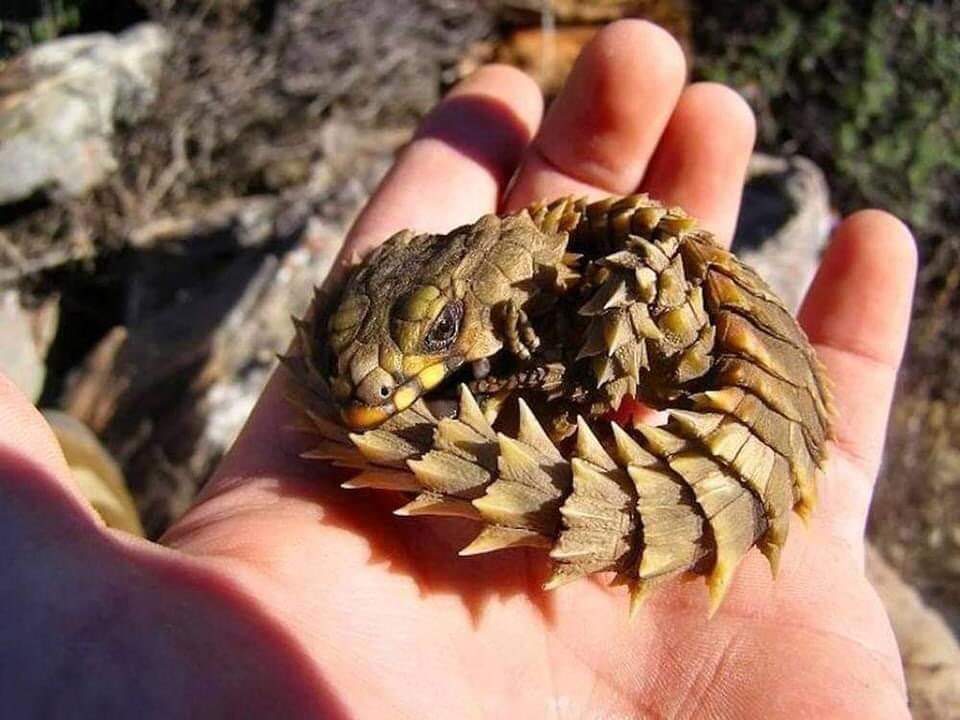
This is an Armadillo Lizard, aka Dragon Baby.


Armadillo lizard, also known as armadillo spiny-tailed lizard or armadillo girdled lizard is a reptile that can be found only on the western coast of South Africa. 

When danger threatens, it forms a ball by rolling on its back and taking its tail in its mouth. Protected by hard, bony scales and spines on the head and tail, the armadillo lizard remains in this position until the danger disappears.

Armadillo lizard inhabits deserts, scrublands and dry, rocky areas. Because of their unusual look, armadillo lizards are collected from the wild and sold in the pet shops around Europe and North America. 

High demand for armadillo lizards and well developed pet trade negatively affects their number in the wild. 

Armadillo lizards are listed as vulnerable (they may become endangered in the near future).


Photos belongs to their respective owners

Comments

Post a Comment

Popular posts from this blog

Graceful hunter of the skies: The Black-winged Kite, where elegance meets precision

The black-winged kite (Elanus caeruleus) is a small raptor known for its striking appearance, with predominantly white plumage and distinctive black wingtips. It's often observed hovering while hunting for small mammals and insects. The black-winged kite is found in various habitats, including grasslands, marshes, and agricultural areas across parts of Europe, Africa, Asia, and Australia. Its diet primarily consists of small mammals like rodents, along with insects and birds. These kites are known for their remarkable hovering ability, which they use to locate prey before descending rapidly to catch it. They have a graceful flight pattern and are easily recognizable by their contrasting black shoulder patches and wingtips against their otherwise white plumage. Black-winged kites are generally monogamous, forming pairs that collaborate in raising their chicks. Their nests are often built in trees or on tall structures, and they may also use old crow or raptor nests. These kites are ...

Are Monkeys Smarter Than Humans? New Study May Have Some Answers

  Well, it seems that monkeys have been shown to be more adaptable than humans. Although a Planet of the Apes scenario still looks quite far-fetched, and our position as the planet's dominant species is still undisputed, it's an interesting study that reveals a lot about the way we think and do things. Published in Nature's Scientific Reports , the study looks at the cognitive flexibility, meaning the mental ability to adapt to new ways of doing things, of humans compared to capuchin monkeys and rhesus macaques. By using a nonverbal computer task, participants were urged to follow one set of rules, which then changed midway during the study. How well the participants adapted to this change in rules provides tremendous insight. Participants, which comprised of 60 humans, 22 capuchin monkeys, and 7 rhesus macaques, were tested on a common cognitive flexibility experiment called the Learned Strategy–Direct Strategy (LS–DS) task. Participants had to learn to complete tasks in a...

Whispers in the Dark: The Enigmatic Charm of Owls Revealed

Owls are fascinating creatures! Did you know that they can rotate their heads up to 270 degrees? This is possible due to their flexible neck arteries that prevent blood flow interruption when turning. Additionally, owls are known for their silent flight, thanks to specialized feathers that reduce turbulence. Owls are remarkable hunters with specialized adaptations. Their facial discs help funnel sound to their ears, allowing them to locate prey with exceptional precision. Also, owls have asymmetrical ear placements, aiding in pinpointing the source of sounds accurately. Some owl species, like the barn owl, have unique heart-shaped facial patterns. Owls have excellent low-light vision, adapted for hunting during dusk and dawn. Their large eyes are fixed in their sockets, but they can rotate their heads almost completely, compensating for limited eye movement. Additionally, owl feathers have serrated edges, reducing aerodynamic noise during flight and enhancing their stealth as nocturnal...